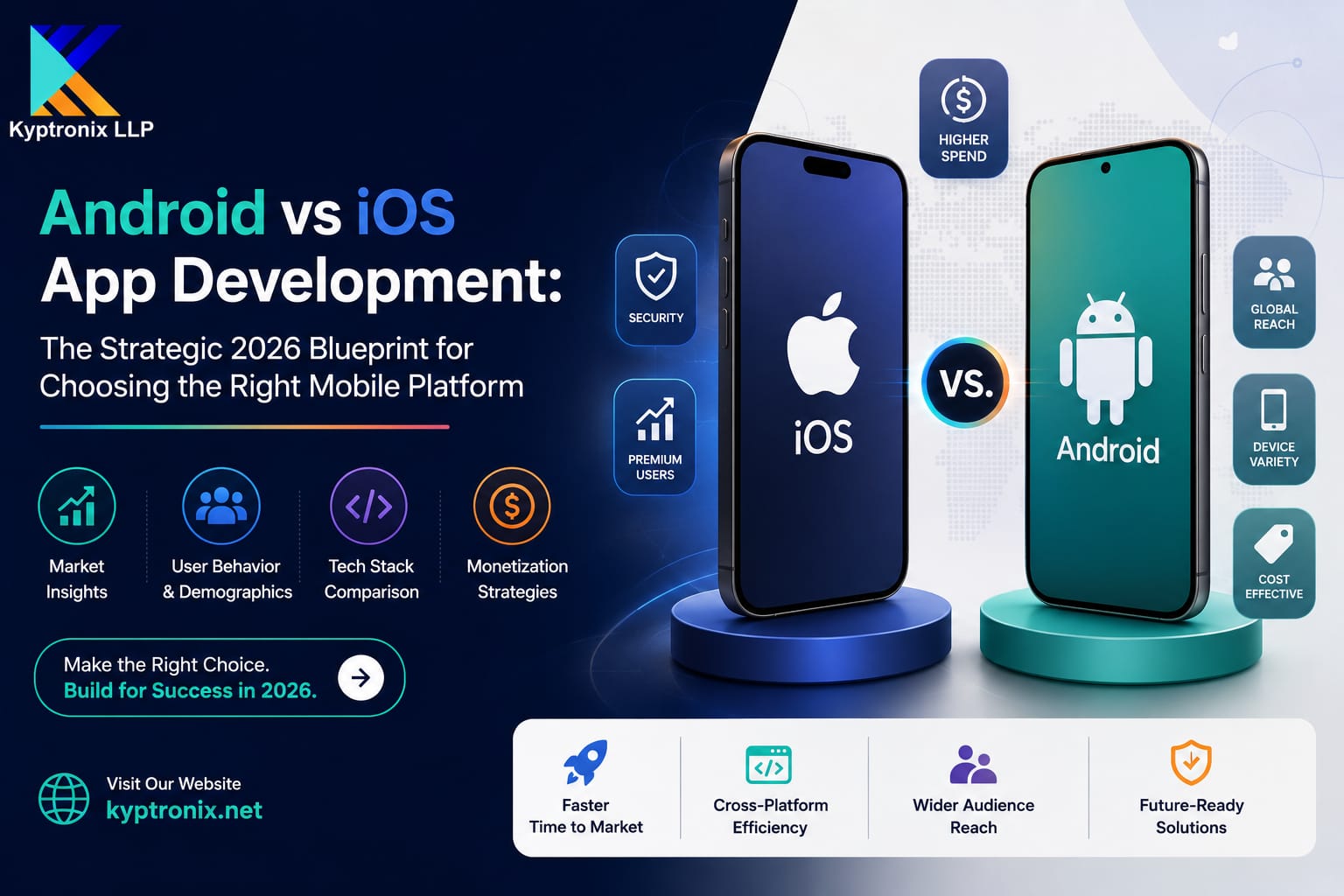
Android vs iOS App Development: The Strategic 2026 Blueprint for Choosing the Right Mobile Platform
Imagine you have just finalized the internal roadmap for a digital product designed to transform your operations or conquer a consumer market. The user workflows are mapped, the financial models look promising, and your team is eager to launch. But right before the engineering kickoff, your leadership team arrives at an absolute make-or-break crossroads, saying, “Should we launch this application on Android, target iPhone users first, or take a massive financial leap and build for both simultaneously?”
If you have consulted with industry peers or read articles online, you have likely run into strong, contrasting opinions. A developer might tell you that iOS is the only way to generate serious subscription revenue. At the same time, a global marketing manager will insist that ignoring Android means cutting off access to 70% of the world's smartphone users.
The reality is that evaluating Android vs iOS App Development is not a simple game of crowns. Choosing your launch platform is one of the most significant strategic decisions your enterprise will make. It determines your initial time-to-market, shapes your customer acquisition costs, dictates your technical architecture choices, and directly impacts your long-term return on investment (ROI).
As we navigate through 2026, the mobile landscape has become deeply sophisticated. Software tools, such as advanced cross-platform frameworks, have altered the economics of dual-platform launches. Yet the cultural, behavioral, and geographical differences between the two user bases remain as distinct as ever.
Whether you are a startup launching a lean prototype or an established brand scaling your digital footprint, this deep-dive guide breaks down the data, engineering realities, and market behaviors to help you chart the perfect mobile path.
The Big Picture: Global Market Share and Geographic Reality
To make a calculated business decision, you must first look at where the global target audience actually spends its screen time. The division between these two mobile operating systems is heavily shaped by geography and local economics.
Let us look at a realistic breakdown of how smartphone market shares are distributed across global manufacturing shipments and active users:
When you analyze these numbers globally, Android maintains a massive, undisputed volume advantage, consistently capturing roughly 70% to 72% of the total worldwide smartphone user base. Apple's iOS commands a smaller but highly concentrated footprint of around 27%-28% globally.
However, if your business base or target audience is located in specific high-income economic zones, that global data shifts completely upside down:
- The North American Market (US & Canada): In the United States, Apple is the dominant leader, with iOS regularly capturing 55% to 60% of the active mobile market share. If you are launching a mobile product focused strictly on US consumers, prioritizing the iPhone is a standard baseline approach.
- The European Landscape: Western Europe displays a highly competitive, nearly even split between the two systems. However, as you travel into Eastern Europe, Android's market share quickly climbs past 70%, driven by a massive variety of mid-tier consumer devices.
- Emerging Global Economies (India, Latin America, Southeast Asia): In fast-growing economic regions, for example, India or Brazil, Android is the overwhelming standard, frequently capturing 85% to 95% of the entire active mobile ecosystem.
The Geographic Rule of Thumb: If your business strategy requires reaching a broad global audience or expanding rapidly within emerging markets, Android is your essential foundation. Conversely, if your product targets corporate environments, high-income professionals, or consumer audiences in the US, starting with iOS provides a highly direct pathway to your core users.
User Demographics and Behavioral Realities
Understanding the raw number of devices in the wild is only the first step. To build a successful application, you must also look closely at the distinct user psychology, spending behaviors, and demographic realities that set these two groups apart.
When you look at the economics of Android vs iOS App Development, you are essentially looking at two entirely different consumer mindsets:
1. The iOS User Profile: Premium Intent and High Lifetime Value
Historically, because Apple positions its hardware strictly within premium pricing tiers, its user base is highly concentrated among middle-to-high-income demographics.
Willingness to Spend: iPhone owners have a significantly higher willingness to open their digital wallets. They consistently outspend Android users by a factor of nearly 2 to 1 when it comes to purchasing premium app downloads, funding in-app digital goods, and maintaining recurring software subscriptions.
E-Commerce Engagement: Studies tracking digital retail traffic consistently show that iOS users complete transactions with higher average order values. They are highly active consumers in industries like luxury retail, mobile banking, health and wellness services, and professional productivity suites.
2. The Android User Profile: Global Scale and Varied Engagement
Android's immense strength is its accessibility. Because the operating system runs on thousands of different hardware configurations, ranging from $100 budget smartphones to $1,500 premium flagship devices, it attracts an incredibly diverse global community.
High Engagement, Low Friction: Android users are highly tech-savvy and download a massive number of applications each month. However, they display a strong cultural preference for free, ad-supported software models over direct upfront payments.
Customization and Technical Freedom: The typical Android customer deeply appreciates personal control over their device. They are highly receptive to custom utility software, open integration features, media management tools, and applications that give them the freedom to configure their user experience exactly how they like.
Monetization Mechanics: Mapping Your Revenue Strategy
Your monetization model must play directly to the strengths of the platform you choose. Forcing the wrong revenue generation model onto the wrong user base is one of the quickest ways to stall your product's growth.
Let us compare how the financial ecosystems of the two major digital app stores operate in practice:
Apple App Store: The Premium Capital Hub
If your business plan depends on users paying directly for your software, such as a monthly subscription for a professional SaaS tool, a paid download for a utility app, or digital purchases inside an educational course, the iOS App Store is a fantastic revenue engine.
Even though Apple has a significantly smaller total user base worldwide, its store consistently generates roughly 60% to 65% of all global app store consumer spending. If you want to generate immediate software revenue without relying heavily on advertising networks, launching on the iPhone first is an exceptionally logical step.
Google Play Store: The High-Volume Conversion Platform
If you choose to launch on Android, your strategy must pivot toward capturing monetization through high volume. Because Android users are more resistant to upfront paywalls, successful applications on this platform typically rely on alternative models:
- In-App Advertising (IAA): Utilizing reward-based video ads, native banners, and interstitial placements to monetize massive, active daily user bases.
- The Freemium Pivot: Offering a fully functional, excellent free experience while locking only ultra-premium or specialized features behind an in-app purchase tier.
- Mobile E-Commerce: Using the app as a free convenience channel to drive real-world physical transactions, such as food delivery orders, product marketplace sales, or logistics bookings.
Engineering Realities: Technical Speed, Code, and Fragmentation
From a software engineering perspective, the technical journey of building, testing, and maintaining these two types of applications involves completely different operational realities.
When analyzing the engineering side of Android vs iOS App Development, your technical leads must plan around distinct platform complexities:
1. The Android Fragmentation Challenge
The single greatest engineering headache in the Android ecosystem is device fragmentation. Your application cannot just run perfectly on a test phone on your developer's desk. It must perform flawlessly across thousands of unique device models manufactured by Samsung, Google, Xiaomi, Vivo, and Oppo.
Screen and Hardware Variety: Your design and engineering teams must account for an endless variety of screen dimensions, aspect ratios, processor speeds, camera configurations, and custom manufacturer software skins.
The Testing Burden: This immense variety requires extensive, rigorous quality assurance testing pipelines. Your team must test layouts across multiple physical configurations to prevent visual bugs and ensure memory usage is highly optimized for lower-end devices.
2. The iOS Ecosystem Control
Apple maintains strict, absolute control over its entire hardware and software stack. Your developers only need to optimize for a tiny, highly predictable family of active iPhone devices and standard screen sizes.
Modern OS Adoption: iPhone users update their operating systems incredibly fast. Within a few months of a major new iOS release, 80% to 85% of the active user base is running the newest software version. This allows your developers to safely use modern system tools and clean code libraries without worrying about supporting legacy operating system bugs.
The Review Gatekeepers: The trade-off for this clean ecosystem is Apple's rigorous, hands-on review process. Apple's store reviewers thoroughly audit every single app submission against strict human interface guidelines, performance benchmarks, and user data privacy standards, which can occasionally lead to unexpected compliance delays during your initial launch.
The Hybrid Alternative: The Power of Modern Cross-Platform Engineering
For many years, businesses were forced to treat this decision as a rigid, binary choice: either spend your entire budget to build two completely separate native applications, or accept a massive drop in visual quality by using early web-based hybrid wrappers.
Fortunately, as we move through 2026, the technology has advanced dramatically. Modern cross-platform frameworks have completely changed the rules of mobile product development:
By leveraging premier, production-ready frameworks such as Google's Flutter or Meta's React Native, your engineering team can write a single, unified codebase that contains the shared business logic, state management, and user interface. That single code repository is then compiled down and deployed natively to both iOS and Android devices simultaneously.
The Clear Business Advantages of Cross-Platform Tools
- Massive Cost Efficiency: Because up to 85% of your application's source code is shared across both platforms, you only need to fund, manage, and scale a single unified team of developers, reducing your upfront production costs by 30% to 45%.
- Accelerated Time to Market: Instead of managing two independent launch schedules, you can push features, patch unexpected bugs, and launch marketing updates across both storefronts at the same time.
- Pixel-Perfect Branding: Modern rendering engines, such as Flutter's Impeller engine, render every visual asset straight onto the device's screen via the GPU, guaranteeing your app looks identical and runs smoothly at 120 frames per second on both operating systems.
When to Avoid Cross-Platform: While cross-platform tools are ideal for 90% of traditional business, SaaS, and e-commerce applications, you should still choose a dedicated native development track if your product requires intense 3D graphical processing, heavy augmented reality (AR) features, or deeply continuous background hardware communication like advanced Bluetooth medical device integrations.
The Strategic Choice: How Should Your Enterprise Decide?
To help your leadership team make the final decision with absolute confidence, let us synthesize these variables into a clear, strategic selection blueprint:
1. Choose iOS First If:
- Your primary customer base resides in North America, the UK, or high-income demographic brackets.
- Your monetization model relies heavily on direct user subscriptions, digital in-app purchases, or paid premium downloads.
- Your internal development timeline is highly compressed, and you want to avoid the testing complications caused by Android device fragmentation.
- Your product integrates deeply with premium corporate networks or enterprise systems that favor Apple's ecosystem control.
2. Choose Android First If:
- Your target audience is global, particularly within rapidly expanding markets across Asia, Latin America, and Africa.
- Your business plan focuses on achieving massive scale quickly and monetizing via advertising networks, mobile e-commerce transactions, or value-added services.
- Your application requires unique technical permissions, deep custom file management, or direct integration with third-party physical hardware components.
- Your target audience values customization and expects a highly flexible, unconstrained software utility.
3. Choose Both Simultaneously (Via Cross-Platform Frameworks) If:
- You want to maximize your brand reach on day one without blowing out your development budget or having to manage two separate engineering teams.
- Your application's core functionality centres on displaying data dashboards, processing user forms, managing e-commerce shopping carts, or handling media content feeds.
- You want to maintain a highly synchronized, agile product release schedule, ensuring all your users receive the same features and security patches at the same moment.
Conclusion: Let Us Build Your Complete Mobile Strategy Together
Making the right choice in the Android vs iOS App Development debate is not about searching for an absolute, universal answer. It is about deeply understanding your target users' daily habits, respecting your operational budget runway, and choosing the precise technology stack that sets your business up for long-term growth.
Navigating this complex technical and strategic landscape requires an experienced technology partner who can help you turn high-level business goals into clean, reliable, and high-performance software code.
At Kyptronix, we cut through the confusion and tech hype. We don't believe in generic, cookie-cutter development models. Our experienced team of product managers, UI/UX designers, and full-stack software engineers boasts a proven track record of delivering elite native iOS apps, high-performance Android solutions, and deeply optimized cross-platform ecosystems. We work closely with your leadership team to analyze your target demographic data, evaluate your feature requirements, and build a beautiful, secure mobile product designed to drive measurable business results.
Ready to take your product from concept to an active app store listing? Connect with the mobile product experts at Kyptronix.net today to schedule your comprehensive technical consultation.
Frequently Asked Questions (FAQs)
Building an Android application natively typically requires a slightly larger initial budget and a longer quality assurance timeline. This is driven entirely by device fragmentation. Your development team must spend extra hours testing layouts, optimizing code performance, and fixing bugs across dozens of unique screen sizes and manufacturer hardware configurations. In contrast, iOS apps only need to support a small, highly standardized family of iPhones.
Apple builds and positions its hardware strictly within premium pricing tiers, which concentrates its user base among middle- to high-income demographics. Culturally, iPhone owners have become highly accustomed to purchasing premium software subscriptions and funding digital in-app goods. In contrast, the global Android audience leans strongly toward free, ad-supported software models.
Yes. By partnering with a team that uses modern cross-platform frameworks like Flutter or React Native, you can write a single, shared codebase that compiles natively and runs beautifully on both iOS and Android. This unified engineering strategy cuts your development timeline nearly in half and saves up to 45% of your production budget compared to building two separate native apps.
Once your application build is submitted, Apple's manual and automated review process typically takes between 24 hours and 3 days to clear. The Google Play Store review process can sometimes take slightly longer, typically between 3 and 7 days, as their automated security scanning systems extensively test applications for malware and policy compliance across various simulated device environments.
To publish your application, you must maintain active developer accounts. Apple charges an ongoing annual developer subscription fee of $99. Google Play requires a simple, one-time registration fee of $25 for a lifetime developer account.
An Android application can communicate easily with cloud-based services and general cross-platform databases. However, it cannot interact directly with Apple's secure, closed on-device features, such as Apple Intelligence system contexts, local iMessage extensions, or system-level App Intents, which are strictly reserved for native iOS applications.
A Minimum Viable Product (MVP) is a lean, highly stable version of your application that contains only your absolute, core features. If your budget is limited, launching an MVP on a single platform (or via a cross-platform framework) allows you to enter the market quickly, gather real-world user feedback, and validate your business assumptions before committing heavily to secondary features.
Both platforms enforce incredibly strict user data privacy standards. Apple relies heavily on its App Tracking Transparency (ATT) framework, which requires users to explicitly opt in before an application can track their behavior across third-party apps and websites. Android uses its advanced Privacy Sandbox system, which restricts cross-app tracking while providing alternative, privacy-preserving API pathways for targeted advertising.
With millions of applications competing for attention on both digital storefronts, you cannot simply cross your fingers and hope users discover your app on their own. App store optimization involves researching high-intent keywords and integrating them naturally into your titles, descriptions, and metadata to boost your organic search rankings and drive consistent, free user downloads.
You should plan to allocate roughly 15% to 20% of your initial total app development budget each year for ongoing maintenance. These funds are essential to cover cloud server hosting fees, deploy routine security patches, fix minor bugs reported by real users, and ensure seamless compatibility with annual iOS and Android operating system upgrades.