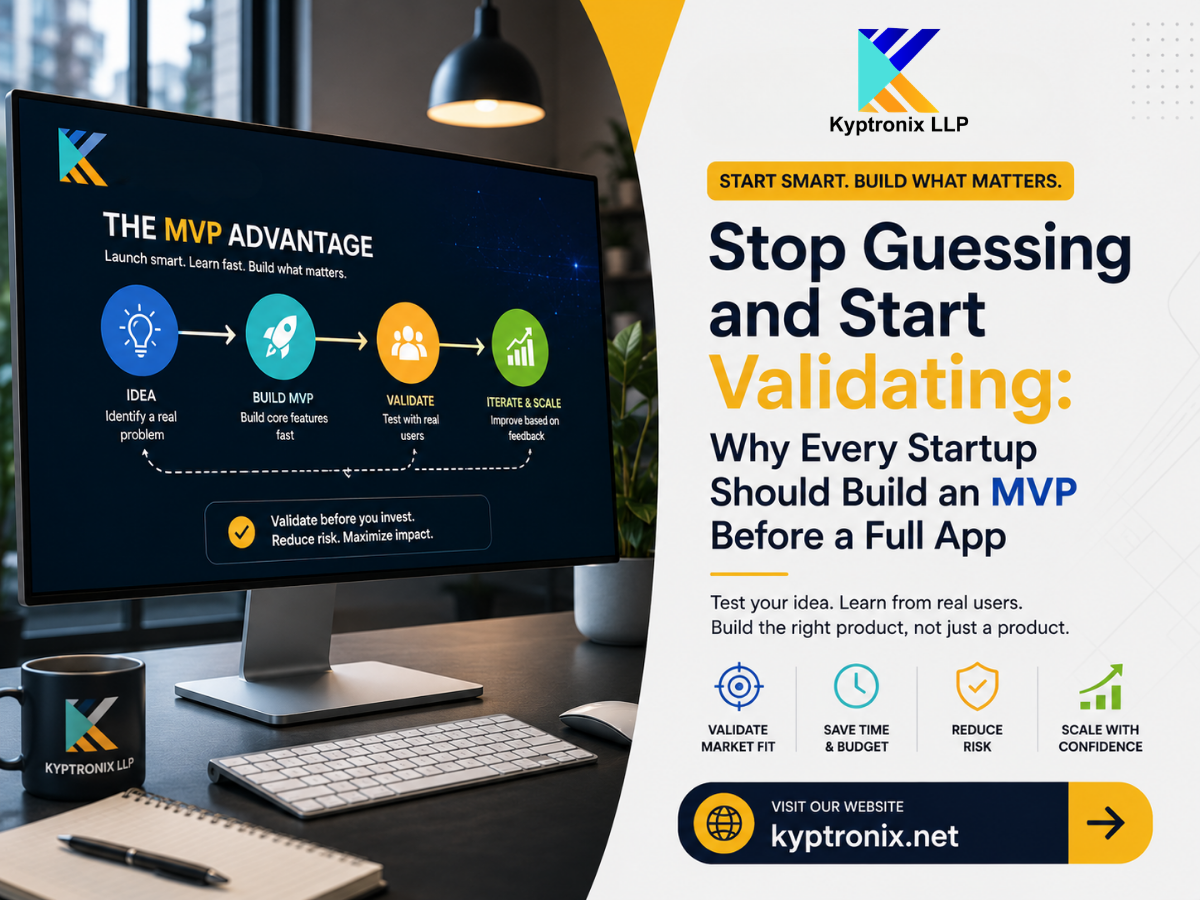
Stop Guessing and Start Validating: Why Every Startup Should Build an MVP Before a Full App
Imagine you are standing at the absolute center of your startup journey. You have identified a massive, painful problem in the market, sketched out a beautiful mobile solution on your digital whiteboard, and gathered a small, dedicated core team. The energy in the room is electric. The feature ideas are flowing freely, like advanced AI personalization engines, frictionless multi-currency payment walls, custom data dashboards, and a hyper-smooth layout. You feel completely ready to invest your entire life savings or your first pre-seed funding round into building the ultimate, fully loaded application.
But then a critical, defining question forces you to pause: “What if we spend six months building this entire ecosystem, only to find out that nobody actually wants to use it?”
If you have spent any time observing the modern digital ecosystem, you already know that this scenario isn't just a worst-case hypothetical. It is the real-world operational reality for the vast majority of technology startups. Building a highly successful mobile application is a multi-dimensional puzzle. The line separating a multi-million-dollar digital market disruptor from an abandoned software asset comes down to how you choose to launch.
In the past, launching a tech company required a high-stakes, all-or-nothing approach where you built the complete product behind closed doors and prayed for a massive reception on launch day. However, as we navigate through 2026, the rules of the game have fundamentally changed. Startups face shorter user attention spans, intense AI-driven competition, and strict investor demands for immediate capital validation.
This comprehensive, data-backed guide explores why adopting the lean startup methodology and building a Minimum Viable Product (MVP) before a full-scale launch is the smartest, most profitable move your business can make this year, with the help of an MVP app development company.
The Alluring Trap of the “Perfect” Launch
It is incredibly easy for first-time founders to fall in love with their own technical solutions rather than focusing deeply on the underlying customer problem. When you spend weeks or months thinking about a product concept, it begins to feel completely real and essential to you. This emotional investment often leads teams to sprint straight into custom development, treating the launch as a grand showcase of every single imaginative bell and whistle.
The hidden danger of chasing this perfect, all-inclusive launch is that it completely insulates you from the real market. Every extra feature you add before getting your product into the hands of actual users introduces new technical assumptions, lengthens your production timeline, and drains your financial runway.
By the time you finally publish the app to the storefronts, you have burned through your entire budget without collecting a single point of real-world user interaction data. If your core market assumptions are even slightly off, you are left with zero capital to pivot or adapt.
Decoding the Numbers: Why Unvalidated Scaling Kills Startups
Let us look past the general startup myths and examine the actual, unvarnished data to understand why so many digital products fail to survive. While you often see headlines stating that 90% of all tech startups crash in their infancy, longitudinal research from the U.S. Bureau of Labor Statistics paints a much more precise and instructional picture:
- 21.5% of early-stage startups fail within their very first year of operations.
- 48.4% close their doors by year five.
- 65.1% vanish from the market within ten years.
When you look into the underlying reasons behind these failures, a striking pattern emerges. Comprehensive data post-mortems conducted by industry analysts at CB Insights reveal that the number one cause of startup mortality is not a lack of capital or fierce competitive pressure; it is simply a lack of market need.
Approximately 42% to 43% of failed companies shut down for the same reason: they spent their entire budgets building a highly sophisticated software product, only to discover too late that the target audience simply did not care enough to pay for it.
The Core Differences: MVP vs. Full-Scale Application
To make an objective strategic decision, you must understand exactly how a Minimum Viable Product differs from a traditional Version 1.0 release. An MVP is not a broken, lazy, or incomplete application; it is a highly stable, hyper-focused version of your product designed to answer critical business questions.
The table below outlines how these two development paths compare across critical operational and financial dimensions:
| Strategic Dimension | Minimum Viable Product (MVP Build) | Full-Scale Software Application (V1.0) |
|---|---|---|
| Core Product Objective | Validating product-market fit via real user interaction | Scaling user acquisition and capturing broad market share |
| Feature Set Scope | Exclusive focus on the primary core value feature | Massive suite of secondary features and deep custom workflows |
| Average Timeline to Launch | 6 to 12 weeks of structured engineering | 6 to 14+ months of continuous dark development |
| Financial Exposure Risk | Low to Moderate ($15,000 – $40,000 range) | High to Extreme ($100,000 to $300,000+) |
| Engineering Workflow | Driven by a highly flexible, agile development workflow | Built on long-term, rigid production timelines |
Unlocking the Business Value: Core Minimum Viable Product Benefits
When you choose to partner with a professional MVP app development company, you are not just saving money on code; you are actively optimizing your entire operational business model. Let us look at the key minimum viable product benefits that give early-stage startups a massive competitive edge:
1. Achieving a Faster Time to Market
In the hyper-accelerated technology landscape of 2026, speed is a definitive business moat. If you identify a genuine market opportunity, you can rest assured that other teams around the globe are looking at the same gap.
Spending a year building a full-scale product gives your competitors an enormous window to beat you to the punch. Focusing strictly on essential functionality allows you to shrink your time to market down to a matter of weeks, capturing early brand authority and establishing your market footprint ahead of the crowd.
2. Radical Optimization of Initial Capital
Every single custom code integration, multi-role user permission structure, and advanced data dashboard costs money to build, test, and maintain. When you ruthlessly narrow your launch scope, you protect your cash reserves.
This lean approach ensures that you only allocate your precious capital toward features that users have explicitly proven they need, entirely eliminating the common waste of funding features that end up completely ignored post-launch.
3. Creating an Ironclad Case for Venture Capital Funding
The fundraising landscape for tech startups has become incredibly disciplined. Modern angel investors and venture capital firms are no longer willing to write large checks based solely on a flashy pitch deck or a high-fidelity design prototype. They want to see real traction metrics.
Launching a live, working MVP that boasts strong initial user retention, consistent organic downloads, and active daily engagement gives you an incredibly strong fundraising position. It proves to investors that you know how to execute efficiently and that a real market demand exists for your product.
The Strategic Engineering Advantage: Mitigating Risk in the Software Development Lifecycle
From a pure technical management perspective, integrating a lean MVP stage completely reshapes your software development lifecycle for the better. It allows your engineering leadership to uncover real-world systemic risks before they cause major financial damage.
When you deploy a focused agile development workflow, your engineering team builds the application in highly organized, iterative 2-week sprints. This means that the core infrastructure, i.e., your server setups, database management systems, and basic API connections, gets thoroughly stress-tested by real users very early in the project lifecycle.
If your developers encounter unexpected performance bottlenecks, scaling issues, or cloud communication delays, they can easily patch and adjust the underlying code architecture. This iterative approach is significantly faster and less expensive than trying to untangle a massive web of broken dependencies across a bloated, multi-featured platform late in the game.
Furthermore, utilizing rapid prototyping methodologies during this early window allows your product designers to quickly validate user flows and screen transitions before the backend team spends hours writing custom code. This smooth coordination keeps your development velocity high and ensures your team remains laser-focused on what matters most.
Turning User Feedback Loops into Your Ultimate Product Weapon
The most valuable asset an early-stage startup can possess is not proprietary code; it is an active, open communication network with its first wave of passionate early adopters. Building a lean product allows you to establish highly responsive user feedback loops that take the guesswork entirely out of your feature planning roadmap.
When real people interact with your shippable MVP, they will use it in ways you never could have anticipated in your closed strategy meetings. They will highlight minor usability friction points, uncover hidden bugs, and explicitly tell you which features add the most value to their daily routines.
This real-world qualitative and quantitative data acts as your absolute guiding light. Instead of relying on internal assumptions to guess what features to build next, your engineering team can construct updates based on explicit, verified customer demand. This user-driven approach naturally builds deep brand loyalty, converting your early testers into vocal advocates who drive organic growth.
Navigating App Development Costs Safely
Let us talk openly about money. One of the most common reasons startups run into financial trouble is a simple lack of understanding regarding the realistic market costs of software engineering. They frequently underestimate the budget required to build production-grade platforms and fail to plan for the ongoing expenses that accumulate after launch.
To help you plan your finances realistically, let us break down how modern app development costs are typically distributed across different project scopes and engineering regions:
Estimated Production Benchmarks by Scope
- Simple Mobile MVP ($15,000 – $40,000): Focuses strictly on a single mobile platform or uses a unified cross-platform framework to deliver your core value feature with basic data storage and clean, template-based user paths.
- Mid-Range Commercial App ($40,000 – $100,000): Includes fully custom UI/UX design, secure payment gateway integrations, real-time data synchronization, and a custom administrative management panel.
- Complex Enterprise Platform ($100,000 – $250,000+): Features highly advanced multi-tenant cloud architectures, end-to-end data encryption compliance layers, custom AI feature integrations, and heavy data processing pipelines.
By choosing to launch a lean MVP first, you essentially cap your early financial risk. You can validate your core business model for a fraction of the cost of a full v1.0 system, preserving the majority of your capital to fund future user acquisition campaigns and seasonal feature expansions once your product-market fit is fully proven.
Setting the Stage for Software Scalability
A common concern raised by non-technical founders when discussing MVPs is the fear of technical debt. They worry that building a lean, rapid product means they will inherit messy, fragile code that will need to be completely thrown away and rebuilt from scratch the second their user base starts to grow.
This is where working with a top-tier MVP app development company makes all the difference. A professional engineering firm understands that a true MVP requires a brilliant balance of speed and structural stability.
They build your lean product using modern, modular architectures, such as serverless cloud functions, decoupled APIs, and highly adaptable database schemas. This clean foundation ensures your product maintains elite software scalability. When thousands of new users flock to your platform after a successful marketing push, your system can easily scale its resources up to handle the load, allowing you to add new features smoothly without breaking your stable core.
Partnering with a Specialized MVP App Development Company
Navigating this highly strategic, fast-moving journey takes a unique blend of sharp business analysis, disciplined design thinking, and veteran engineering experience. Trying to manage all of these moving pieces completely on your own or relying on unvetted freelance networks frequently leads to missed deadlines and blown budgets.
At Kyptronix, we treat your startup vision like our very own. We specialize in cutting through the technical noise to help ambitious brands build highly secure, scalable, and beautifully optimized Minimum Viable Products designed to win real market share.
Our experienced global team of product managers, UI/UX designers, and full-stack engineers has a proven track record of helping startups compress their timelines, validate their core concepts, and build a solid technical foundation for long-term growth.
Ready to stop guessing and start building a digital product your users will love? Connect with the product delivery experts at Kyptronix.net today to map out an efficient path to bring your application to life.
Frequently Asked Questions (FAQs)
An MVP is a lean, highly stable version of your application that includes only your core, must-have features. Its primary purpose is to get your main value proposition into the hands of real users as fast as possible so you can gather real-world data and validate your business assumptions before investing heavily in secondary features.
For most standard commercial startups, a professional MVP can be designed, coded, and launched within a clean window of 2 to 4 months. This accelerated timeline is achieved by focusing strictly on essential functionality and utilizing efficient cross-platform development toolkits.
Not at all. A true MVP built by a professional team is exceptionally polished, high-performing, and visually beautiful. The word “minimum” refers strictly to the narrow scope of the feature list, not the quality of the software design or engineering execution.
You must look ruthlessly at your primary core value proposition. Ask yourself: “What is the single, essential action a user must take to solve their problem inside our app?” Every feature that directly enables that action goes into the MVP; every secondary feature goes into your post-launch product backlog.
Investors want to see concrete evidence that your product solves a real problem for a real target audience. Launching an MVP that demonstrates consistent user retention, active engagement, and steady growth proves your business model works, making your startup a much safer and more attractive investment opportunity.
Yes, using modern cross-platform frameworks like Flutter or React Native is highly recommended for startup MVPs. They allow your team to write a single, unified codebase that deploys beautifully to both iOS and Android simultaneously, reducing your initial development costs and testing timelines by up to 40%.
A prototype is a non-functional visual mockup or clickable design asset used to explore layout ideas and pitch early concepts to investors. An MVP is a live, custom-coded software product with a working backend and database, fully prepared for real users to download and interact with.
Establishing clear user feedback loops ensures you build your product roadmap based on real, verified user demands rather than internal assumptions. This data-driven approach keeps your team from wasting time and capital coding complex features that users don't actually care about.
This is actually a major strategic win for your business. Because you launched a lean MVP instead of a full-scale app, you still have plenty of capital, time, and team energy left over. You can analyze user data, pivot your core value proposition, and re-launch a refined solution without facing catastrophic financial loss.
For a typical early-stage startup MVP with a modest initial user base, you should plan to budget around $200 to $500 per month to cover standard operational infrastructure. This includes secure cloud hosting, managed user databases, error tracking tools, and basic third-party API subscription costs.